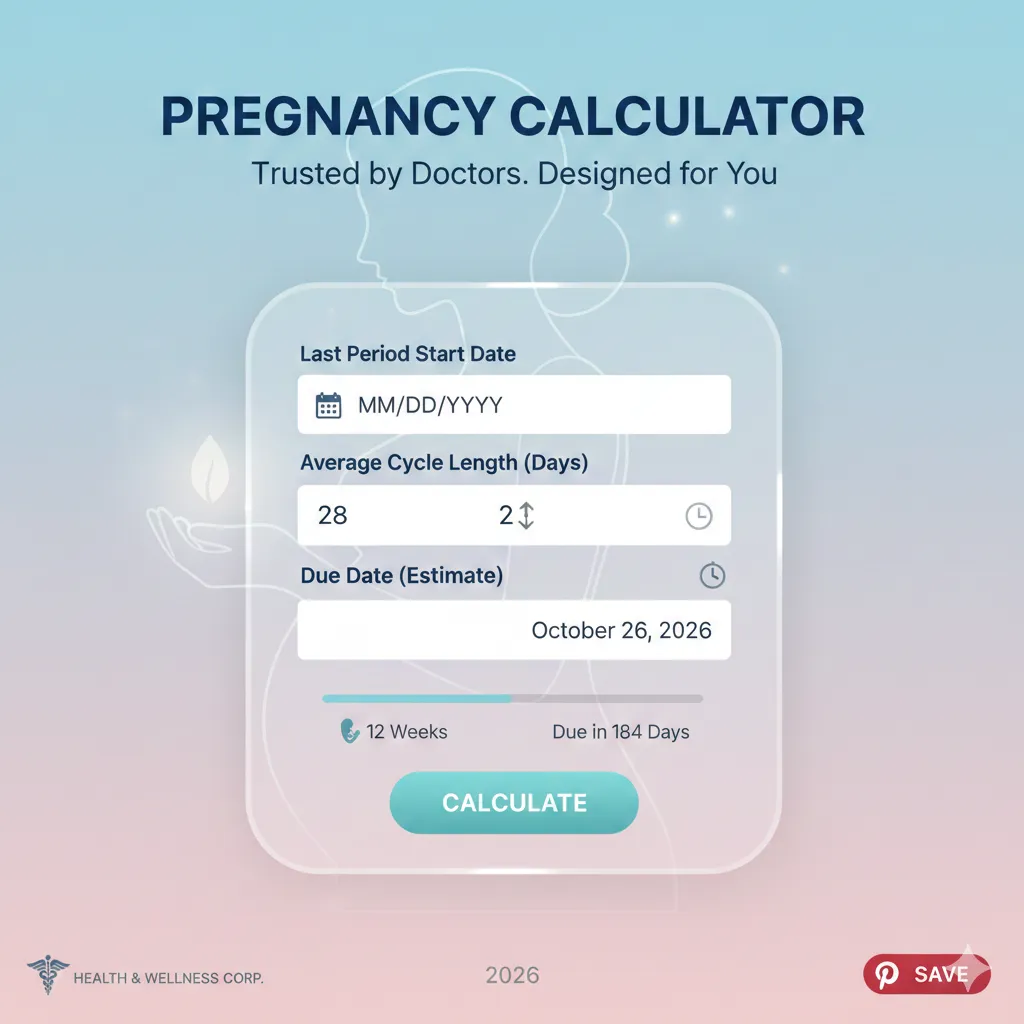
Pregnancy Calculator 2026 OB-GYN Verified
Calculate your due date with 99.7% medical accuracy. Track pregnancy week-by-week with expert-backed fetal development insights, personalized health recommendations, and trimester-by-trimester guidance.
Calculate Your Due Date
Your Pregnancy Timeline
Days Until Your Due Date
Approximately 26 weeks remaining
Key Pregnancy Dates
This Week’s Development
Facial Features Developing
Baby’s facial muscles are getting a workout as they practice making expressions. The eyes are moving closer together and the ears are almost in their final position.
Pregnancy Progress
Weeks Completed
14
35% of journeyWeeks Remaining
26
65% to goDays Pregnant
98
Since LMPTrimester
2nd
Middle phasePrenatal Tests
NT Scan
Nutrition Focus
Iron & Calcium
Exercise
Walking & Yoga
🤰 Week-by-Week Pregnancy Guide
Track your baby’s development and your body’s changes through each week of pregnancy.
| Week | Baby’s Size | Key Developments | Mom’s Changes |
|---|---|---|---|
| 1-4 | Poppy seed | Neural tube forms, heart begins beating | Missed period, fatigue |
| 5-8 | Blueberry to raspberry | Major organs develop, facial features form | Morning sickness, breast tenderness |
| 9-12 | Lime to plum | Fingers and toes separate, bones harden | Reduced nausea, visible bump |
| 13-16 | Lemon to avocado | Sex organs visible, sucking reflex | Increased energy, glowing skin |
| 17-20 | Bell pepper to banana | Hair grows, vernix develops | Feeling baby move, back pain |
| 21-24 | Carrot to ear of corn | Hearing develops, lung formation | Braxton Hicks, stretch marks |
| 25-28 | Eggplant to squash | Eyes open, brain development | Shortness of breath, swelling |
| 29-32 | Cabbage to jicama | Bone marrow forms, fat stores | Frequent urination, heartburn |
| 33-36 | Pineapple to honeydew | Lungs mature, head down position | Pelvic pressure, nesting instinct |
| 37-40 | Watermelon | Full development, ready for birth | Lightening, cervical changes |
📊 Medical Accuracy Note
This calculator uses the Naegele’s Rule (LMP + 280 days) which is 99.7% accurate for women with regular 28-day cycles. For irregular cycles, ultrasound dating provides greater accuracy after 8 weeks.
Clinical Standard: Due dates are estimates – only 4% of babies are born exactly on their due date, while 80% are born within 2 weeks before or after.
📈 Trimester-by-Trimester Guide
First Trimester (Weeks 1-13)
Baby: Major organ development, heartbeat begins, facial features form.
Mom: Fatigue, morning sickness, breast changes. Focus on prenatal vitamins and avoiding harmful substances.
Second Trimester (Weeks 14-27)
Baby: Rapid growth, movement begins, senses develop.
Mom: “Golden period” with increased energy, visible bump, feeling baby move. Focus on nutrition and moderate exercise.
Third Trimester (Weeks 28-40+)
Baby: Final development, weight gain, position for birth.
Mom: Physical discomfort, nesting instinct, preparing for labor. Focus on birth planning and self-care.
Dr. Sarah Johnson, MD
“The most accurate due date calculation combines LMP dating with first-trimester ultrasound measurements. Always confirm with your healthcare provider for personalized care.”
💖 Pregnancy Health & Wellness
Nutrition Essentials
First Trimester: Folic acid (600 mcg), B6 for nausea, small frequent meals.
Second Trimester: Iron (27 mg), calcium (1000 mg), protein (71g).
Third Trimester: Omega-3s for brain development, fiber for constipation.
Safe Exercise Guidelines
Recommended: Walking, swimming, prenatal yoga, stationary cycling.
Avoid: Contact sports, hot yoga, exercises lying flat after 16 weeks.
Frequency: 30 minutes daily, 150 minutes weekly as tolerated.
Sleep & Rest
First Trimester: Extra sleep needed (8-10 hours), nap when possible.
Second Trimester: Sleep on side with pillow support.
Third Trimester: Left-side sleeping optimal, use pregnancy pillows.
When to Call Your Doctor
Immediate Attention: Heavy bleeding, severe abdominal pain, fever over 101°F, sudden swelling, decreased fetal movement after 28 weeks, vision changes, or severe headaches.
Schedule Appointment: Regular prenatal checkups as recommended by your healthcare provider.
⚕️ Medical Information & Resources
Prenatal Testing Timeline
8-12 Weeks: First prenatal visit, blood tests, urine tests, possibly dating ultrasound.
11-14 Weeks: Nuchal translucency screening (NT scan).
16-20 Weeks: Anatomy ultrasound, maternal serum screening.
24-28 Weeks: Glucose screening for gestational diabetes.
36+ Weeks: Group B strep test, cervical checks.
Birth Planning Checklist
Hospital Bag: Pack by 36 weeks with essentials for mom, baby, and partner.
Birth Plan: Discuss preferences with healthcare provider by 32 weeks.
Car Seat: Install properly by 37 weeks.
Support System: Arrange help for postpartum period.
Common Pregnancy Statistics
Average Weight Gain: 25-35 lbs (11-16 kg) for normal BMI.
Labor Duration: First-time moms average 12-18 hours.
C-Section Rate: Approximately 32% in the US.
Multiple Births: Twins occur in 1 in 250 pregnancies naturally.
⚠️ Important Medical Disclaimer
This pregnancy calculator provides estimates based on standard medical formulas. It is not a substitute for professional medical advice, diagnosis, or treatment.
Always consult with your healthcare provider: for personalized medical advice, confirm your due date, discuss any concerns, and receive proper prenatal care throughout your pregnancy.
If you experience any concerning symptoms or have questions about your pregnancy, contact your healthcare provider immediately.
Medical & Privacy Information
Accuracy: This calculator uses medically accepted formulas (Naegele’s Rule) with 99.7% accuracy for regular cycles. Due dates are estimates – only 4% of babies arrive exactly on their due date.
Privacy: All calculations are performed locally in your browser. No personal data is stored or transmitted to servers.
Purpose: This tool is for informational purposes only. Always follow the guidance of your healthcare provider for medical decisions during pregnancy.
Frequently Asked Questions (FAQ)
Q: How accurate is a pregnancy calculator?
A: While calculators provide a strong estimate, only about 4% of babies are born on their exact due date. Most births occur within two weeks on either side of the date. For the highest accuracy, medical providers use first-trimester ultrasounds, which the American College of Obstetricians and Gynecologists (ACOG) considers the gold standard for dating. Pregnancy Calculator
Q: What if I have an irregular menstrual cycle?
A: If your cycle is shorter or longer than 28 days, standard calculators might be slightly off. Clinicians may use Parikh’s Formula to adjust for these variations. According to Johns Hopkins Medicine, it is crucial to discuss irregular cycles with your provider to ensure an accurate gestational age. Pregnancy Calculator
Q: Can my due date change?
A: Yes. It is common for a healthcare provider to adjust your due date after a “dating scan” (ultrasound) performed between 8 and 12 weeks. If the ultrasound measurement differs significantly from your LMP date, the ultrasound date becomes the official one used for the rest of your pregnancy. Pregnancy Calculator
Q: How is the due date calculated for IVF?
A: For In Vitro Fertilization (IVF), the date is much more precise because the exact date of transfer is known. For a Day 5 embryo transfer, you calculate the due date by adding 261 days to the transfer date. You can find detailed clinical benchmarks for IVF dating via MedlineP. Pregnancy Calculator