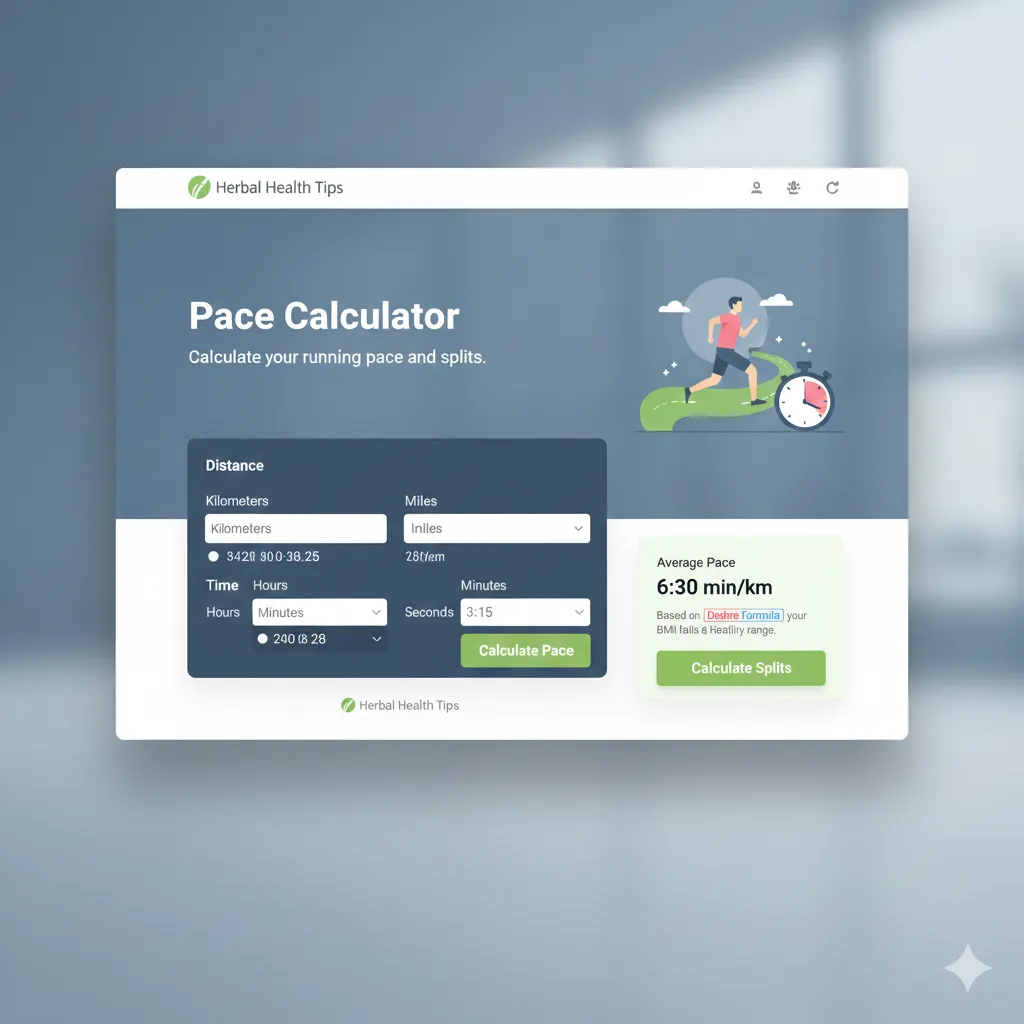
Pace Calculator
Pace Calculator
Calculate Running Pace, Time, or Distance | Find your perfect training pace for any race
Calculate Your Pace
Format: minutes and seconds per mile
Result
Pace (min/mile)
Pace (min/km)
Speed
Split Times
| Distance | Cumulative Time | Split Time |
|---|---|---|
| Enter values to see splits | ||
How to Use the Pace Calculator
This calculator solves for one missing variable (Pace, Time, or Distance) based on the two inputs you provide.
Calculation Modes:
Find Pace: If you provide Distance and Time, calculate Pace (e.g., 8:00 per mile).
Find Time: If you provide Distance and Pace, calculate total Time (e.g., 03:20:00).
Find Distance: If you provide Time and Pace, calculate total Distance (e.g., 26.2 miles).
Quick Tips:
- Leave the field you want to calculate empty
- Use preset buttons for common race distances
- Toggle between miles and kilometers
- Check the split table for detailed pacing
Calculation Formulas
Basic Formulas:
Pace = Time / Distance
Example: 40 minutes for 5 miles = 8:00 min/mile
Time = Distance × Pace
Example: 13.1 miles at 9:30/mile = 2:04:45
Distance = Time / Pace
Example: 1 hour at 10:00/mile = 6 miles
Conversions:
1 mile = 1.60934 kilometers
1 kilometer = 0.621371 miles
Speed (km/h) = 60 / Pace (min/km)
Speed (mph) = 60 / Pace (min/mile)
Common Examples
| Goal | Distance | Pace | Time |
|---|---|---|---|
| 5K Finish Time | 3.1 miles | 8:00/mile | 24:48 |
| Sub-2 Hour Half | 13.1 miles | 9:09/mile | 1:59:59 |
| Boston Qualifier | 26.2 miles | 7:15/mile | 3:10:00 |
| 10K Race Pace | 6.2 miles | 7:30/mile | 46:30 |
Training Pace Examples:
Easy Run: 10:00 – 11:30 min/mile
Tempo Run: 30 seconds slower than 5K pace
Interval Training: 10-15 seconds faster than 5K pace
Long Run: 60-90 seconds slower than marathon pace
Training Tips
Using Pace in Training:
Consistency is Key: Maintain even splits throughout your run. Use the split table to plan your pacing strategy.
Negative Splits: Start slower than your goal pace and finish faster. This is often the most effective race strategy.
Adjust for Conditions: Heat, hills, and wind all affect your pace. Adjust your expectations accordingly.
Race Strategy:
1. Know your goal pace before the race
2. Use the split table to memorize key checkpoints
3. Have backup pacing strategies (A, B, and C goals)
4. Practice your goal pace in training
This pace calculator provides estimates for training and planning purposes. Actual performance may vary based on fitness level, terrain, weather conditions, and other factors. Always listen to your body and train safely.
How to Improve Your Running Pace
Once you know your baseline, use these three strategies to get faster:
Consistency over Intensity: For beginners, simply increasing weekly mileage at an easy pace is often enough to see significant pace improvements. The CDC physical activity guidelines recommend a mix of aerobic and muscle-strengthening activities for peak health.
Interval Training: Alternating between short bursts of high-intensity running and recovery periods. According to research on VO2 max and running performance, intervals are the most effective way to increase top-end speed.
Tempo Runs: Often called “threshold” runs, these are sustained efforts at a “comfortably hard” pace. This trains your body to clear lactic acid more efficiently.
Frequently Asked Questions
What is a “good” running pace for a beginner?
A “good” pace is entirely personal. However, most beginner runners find a comfortable pace between $12:00$ and $15:00$ minutes per mile. The goal is to maintain a “conversational pace”—meaning you can speak in full sentences while running.
How do I convert $min/km$ to $min/mi$?
To convert your kilometer pace to a mile pace, multiply the minutes by $1.609$. For a quick reference, a $6:00$ $min/km$ pace is approximately a $9:40$ $min/mi$ pace.
Should I use a pace calculator for walking?
Absolutely! Walking for fitness is highly effective. Experts at the Mayo Clinic suggest that brisk walking can provide many of the same cardiovascular benefits as running with a lower risk of injury.