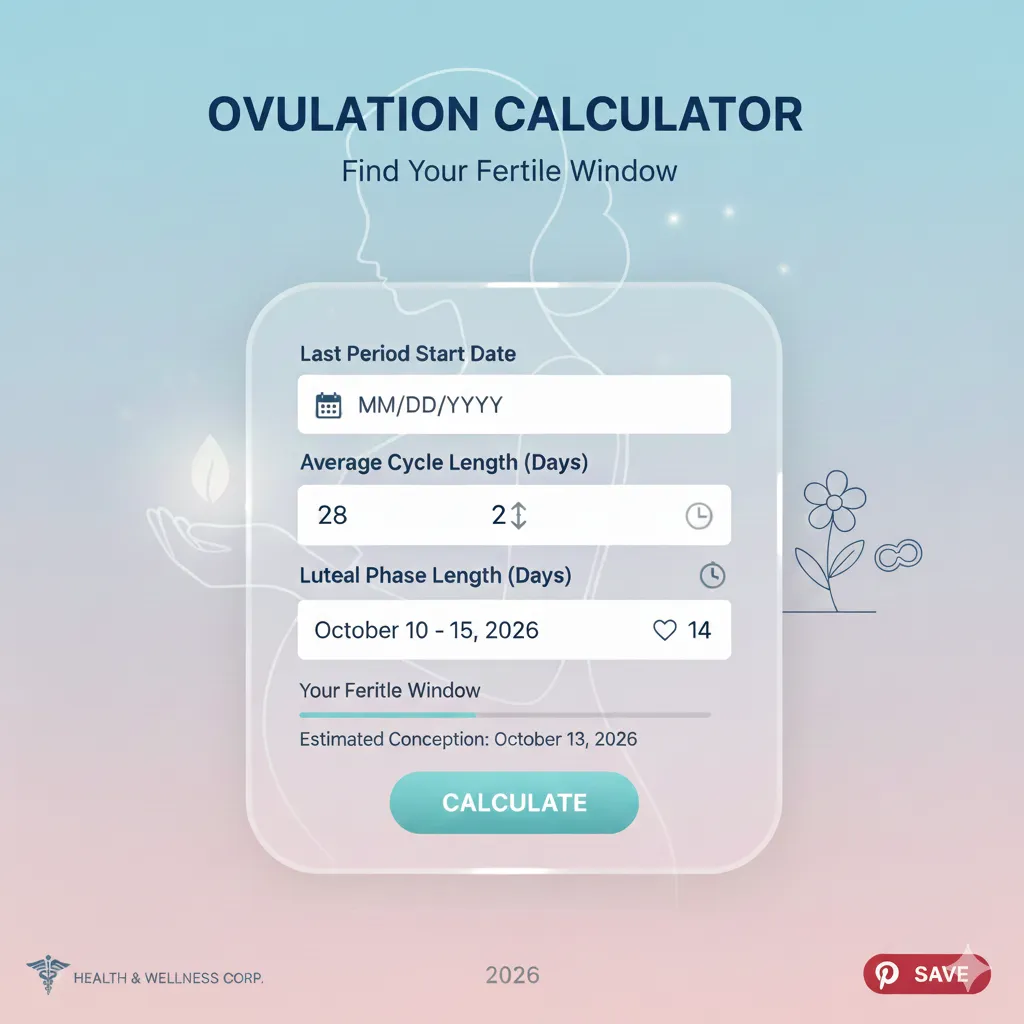
Ovulation Calculator
Track your menstrual cycle and identify your fertility window with this professional ovulation calculator. Input your data below to get accurate predictions.
Cycle Information
Results
Cycle Visualization
Enter Your Cycle Information
Fill in the details on the left and click “Calculate” to see your ovulation dates and fertility window.
Understanding Your Cycle
Ovulation Day
This is when an egg is released from your ovary. It’s the day you’re most likely to conceive if you have intercourse.
Fertility Window
The 5-6 days leading up to and including ovulation. Sperm can live up to 5 days, so intercourse during this window can lead to pregnancy.
Menstrual Phase
The period of bleeding at the beginning of your cycle. This marks day 1 of your menstrual cycle.
Luteal Phase
The time between ovulation and your next period. This phase is typically consistent in length for each person.
Important Disclaimer
This ovulation calculator provides estimates based on the information you provide. It is not a substitute for professional medical advice, diagnosis, or treatment. Always consult with your healthcare provider for personalized guidance regarding fertility and contraception.
Frequently Asked Questions (FAQ)
Q: How accurate is an ovulation calculator?
A: An online calculator provides an estimate based on the average cycle. For users with very regular 28-day cycles, it is highly reliable. However, for those with variations, the American Society for Reproductive Medicine (ASRM) recommends combining a calculator with ovulation predictor kits (OPKs) for the highest accuracy.
Q: Can I conceive if I have irregular cycles?
A: Yes, but pinpointing ovulation is more challenging. Our calculator allows you to enter your average cycle length over the last 6 months to provide a more tailored window. According to Mayo Clinic research, tracking physical symptoms like cervical changes is essential for those with irregular periods.
Q: What is the "Luteal Phase"?
A: The luteal phase is the period between ovulation and your next period. It typically lasts 12–16 days. A short luteal phase (less than 10 days) can sometimes make it difficult for a fertilized egg to implant, a condition often discussed in NIH clinical studies on fertility.
Q: When is the best time to have intercourse to conceive?
A: The two days leading up to ovulation and the day of ovulation itself offer the highest probability of conception. Research from Harvard Health suggests that frequent intercourse throughout the fertile window is more effective than trying to "time" it to a single hour.