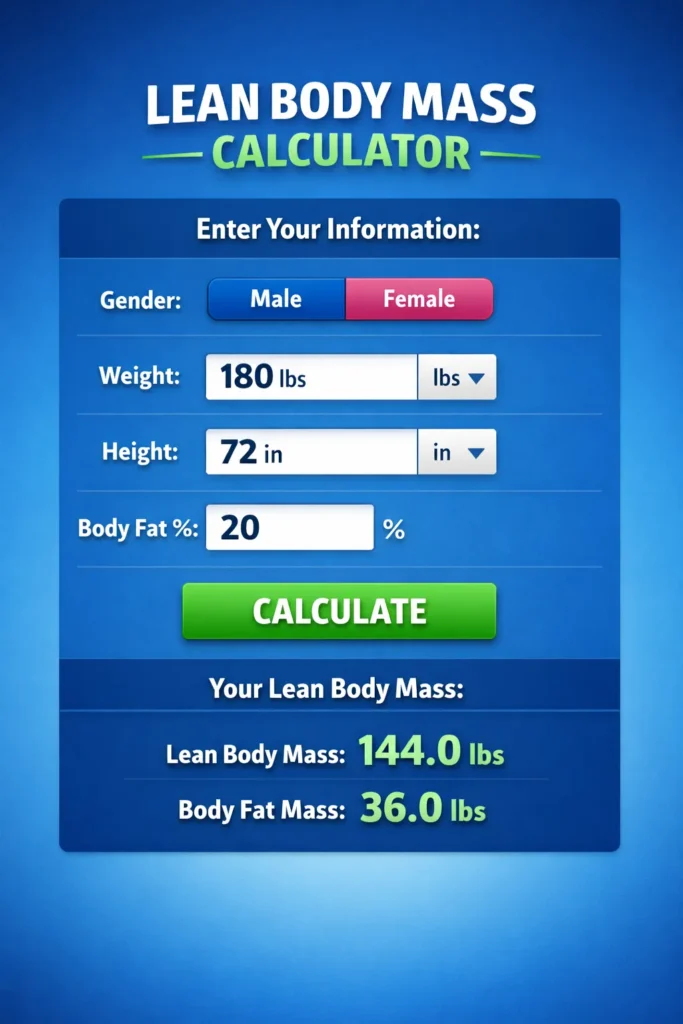
Lean Body Mass Calculator
Calculate Your Fat-Free Mass | Essential for Tracking Body Composition and Muscle Growth
Calculate Your Lean Body Mass
If you know your body fat percentage, enter it for more accurate LBM calculation:
LBM = Weight × (1 – BodyFat%)
Your Body Composition Analysis
Lean Body Mass (Fat-Free Mass)
Lean Mass
Muscle, bone, organs, water
Fat Mass
Essential & storage fat
Body Fat %
Estimated from LBM
Recommended Lean Body Mass Range
Based on your height and gender
What is Lean Body Mass (LBM)?
Lean Body Mass (LBM) is the total weight of your body minus all the fat mass. It includes muscles, bones, organs, skin, and body water—essentially everything in your body that isn’t fat.
Unlike Body Mass Index (BMI), which only considers height and weight, LBM gives you a much clearer picture of your body composition. Two people can have the same weight and height but completely different body compositions—one might be muscular with low body fat, while the other might have higher body fat with less muscle.
Key Components of Lean Body Mass:
- Skeletal Muscle: The muscles attached to your bones that you can control voluntarily
- Bones: Your skeletal structure and bone density
- Organs: Heart, liver, kidneys, brain, and other vital organs
- Body Water: Intracellular and extracellular fluids
- Connective Tissue: Tendons, ligaments, and other connective tissues
Why Lean Body Mass Matters
Metabolic Health
Muscle tissue is metabolically active—it burns calories even at rest. Every pound of muscle burns approximately 6-10 calories per day at rest, compared to fat which burns only 2-3 calories. Increasing your LBM can boost your metabolism and make weight management easier.
Athletic Performance
For athletes, LBM is directly related to strength, power, and endurance. Higher LBM (with appropriate body fat levels) typically means better athletic performance in strength-based sports.
Health and Longevity
Maintaining adequate muscle mass as you age helps prevent sarcopenia (age-related muscle loss), supports bone health, improves insulin sensitivity, and enhances overall quality of life.
Accurate Progress Tracking
When you’re trying to improve body composition, the scale alone can be misleading. LBM tracking helps you understand if you’re losing fat while preserving (or gaining) muscle—the ideal scenario for body recomposition.
How LBM is Calculated
This calculator offers three different formulas for estimating Lean Body Mass. Each has its strengths and is suited for different populations:
Boer Formula (Most Accurate)
Developed in 1984, this is considered one of the most accurate formulas for the general population.
For Men: LBM = (0.407 × weight in kg) + (0.267 × height in cm) - 19.2 For Women: LBM = (0.252 × weight in kg) + (0.473 × height in cm) - 48.3
James Formula
Another well-regarded formula that works well across different body types.
For Men: LBM = (1.10 × weight in kg) - 128 × (weight² ÷ height²) For Women: LBM = (1.07 × weight in kg) - 148 × (weight² ÷ height²)
Hume Formula
Often used in clinical settings and research studies.
For Men: LBM = (0.32810 × weight in kg) + (0.33929 × height in cm) - 29.5336 For Women: LBM = (0.29569 × weight in kg) + (0.41813 × height in cm) - 43.2933
| Formula | Best For | Accuracy |
|---|---|---|
| Boer | General population | High |
| James | Athletes & lean individuals | High |
| Hume | Clinical/research settings | Moderate-High |
Ideal Lean Body Mass Ranges
Your ideal LBM depends on your gender, height, and fitness goals. Here are general guidelines:
Lean Body Mass by Fitness Level
| Height Range (cm) | Men (kg) | Women (kg) |
|---|---|---|
| 150-160 | 48-55 | 40-46 |
| 161-170 | 52-60 | 43-50 |
| 171-180 | 56-65 | 46-54 |
| 181-190 | 60-70 | 49-58 |
| 191-200 | 64-75 | 52-62 |
Note: These are general ranges. Individual variations based on bone structure, genetics, and training history are normal.
Tracking Your LBM Progress
How to Increase Lean Body Mass
- Progressive Resistance Training: Lift weights 3-5 times per week with increasing intensity
- Adequate Protein Intake: 1.6-2.2g of protein per kg of body weight daily
- Calorie Surplus: To build muscle, you need to consume more calories than you burn
- Quality Sleep: 7-9 hours per night for optimal recovery and hormone regulation
- Patience and Consistency: Muscle growth takes time—aim for 0.25-0.5 kg per month
Monitoring Your Progress
Weekly Measurements: Track your weight and take body measurements
Monthly Assessments: Use this calculator monthly to track LBM changes
Progress Photos: Take photos every 4-6 weeks under consistent conditions
Strength Increases: Track your lifting numbers in key exercises
Common Pitfalls to Avoid
- Don’t rely solely on the scale—track multiple metrics
- Avoid excessive cardio that might interfere with muscle growth
- Don’t cut calories too aggressively when trying to build muscle
- Be consistent with your training and nutrition
- Get enough recovery between workouts
Accuracy and Limitations
This Lean Body Mass calculator provides estimates based on population-based formulas. For the most accurate measurements, consider methods like DEXA scans, Bod Pod, or underwater weighing. These estimates don’t account for individual variations in bone density, organ size, or hydration status.
The body fat percentage calculated from LBM is an estimate. If you know your actual body fat percentage from other measurements (calipers, BIA scales, etc.), enter it in the calculator for more accurate LBM calculation. Lean Body Mass calculator
Frequently Asked Questions (FAQ)
Q:What is a healthy Lean Body Mass percentage?
A: While it varies by age and fitness level, healthy ranges are typically: ( Lean Body Mass calculator)
Men: 75% to 85% of total body weight.
Women: 70% to 80% of total body weight.
Q:Is Lean Body Mass the same as Muscle Mass?
A: No. While they are related, Lean Body Mass calculator includes all non-fat components (bones, organs, water), whereas Muscle Mass refers specifically to the weight of your muscles.
Q: How often should I calculate my LBM?
A: For those in a "bulking" or "cutting" phase, checking every 4-6 weeks is ideal. This ensures that weight loss is coming from fat rather than muscle, or that weight gain is primarily muscle tissue. Accuracy Benchmark: DEXA Scans,
Q: Why does my LBM fluctuate?
A: Since water accounts for a large portion of LBM ( Lean Body Mass calculator), changes in hydration, sodium intake, or glycogen storage can cause minor daily fluctuations in your results.Clinical Research: National Library of Medicine (PMC)