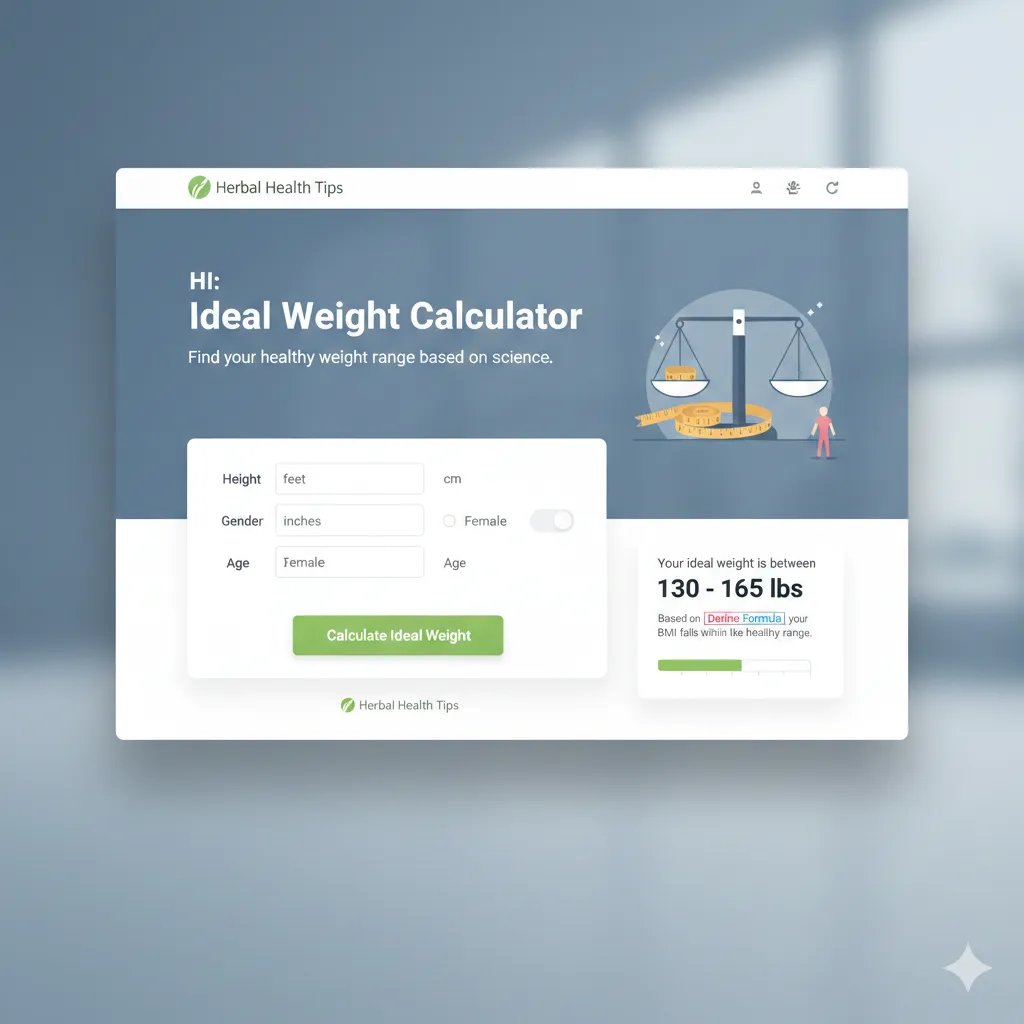
Ideal Weight Calculator
Ideal Weight Calculator
Finding Your Most Healthy Body Range
Calculate Your Ideal Weight
Your Ideal Weight Range
Based on medical formulas for optimal health
Robinson Formula
Most accurate for general population
Miller Formula
Common in clinical assessments
Devine Formula
Originally for medication dosing
Your Body Mass Index (BMI)
BMI range: 18.5 – 24.9 is considered healthy
What is an Ideal Body Weight (IBW)?
Ideal Body Weight (IBW) is a target weight range determined by your height, gender, and age. Unlike a “goal weight,” which might be based on aesthetics, IBW is focused on longevity and reducing the risk of conditions like Type 2 diabetes, hypertension, and heart disease.
In the world of fitness and health, the scale is often the first thing people look at. But what number should you actually be aiming for? While “perfection” is subjective, medical science offers an Ideal Weight Calculator framework to help identify the weight range where your body functions at its peak and your risk for chronic disease is lowest.
Why Knowing Your Ideal Weight Matters
Health Screenings: It serves as a baseline for doctors to assess potential health risks.
Medication Dosage: In clinical settings, some life-saving medications are dosed based on IBW rather than actual weight.
Sustainable Goal Setting: It provides a realistic destination for weight loss or muscle-building journeys.
How the Ideal Weight Calculator Works
Most modern calculators use a combination of Body Mass Index (BMI) and traditional medical formulas. While BMI is a general population tool, IBW formulas offer a more specific target for individuals.
The Robinson Formula: Often considered the most accurate for the general population.
The Miller Formula: Frequently used for clinical assessments.
The Devine Formula: Originally designed for medicinal dosing but widely used in fitness.
How to Move Toward Your Ideal Weight
Calculate Your Calorie Needs: Use your BMR (Basal Metabolic Rate) to find out how many calories you burn at rest.
Focus on Protein: High protein intake helps preserve muscle while you lose fat.
Prioritize Movement: Don’t just “eat less”—focus on moving more through “NEAT” (Non-Exercise Activity Thermogenesis) like walking and taking the stairs.
While this ideal weight calculator uses scientifically validated formulas, it provides estimates for educational purposes only. These calculations don’t account for individual variations in muscle mass, bone density, or specific health conditions. For personalized health advice, consult with a qualified healthcare professional.
Frequently Asked Questions (FAQ)
Is BMI the same as Ideal Weight?
No. BMI is a ratio of height to weight. Ideal Weight is a specific target number (or small range) derived from that ratio and other biological formulas. Ideal Weight Calculator
Can I be healthy if I’m above my “Ideal Weight”?
Yes. “Metabolically healthy” individuals can exist outside the ideal range, especially if they have high muscle mass and low visceral fat (stomach fat).
How often should I check my weight?
For most people, weighing once a week is sufficient. Daily fluctuations are usually just water weight and don’t reflect actual fat loss or gain.
Is this calculator suitable for women?
Yes. It uses gender-specific formulas because women typically have different body composition and hormonal profiles than men. These differences are well-documented in clinical physiology, such as in this PubMed study on body composition
How often should I recalculate my BMR?
You should recalculate your BMR every time you lose or gain about 5kg. As your body mass changes, so does the energy required to maintain it. For those following CDC-recommended weight loss programs, a monthly check-in is ideal.
Can muscle mass affect my results?
Absolutely. Muscle is much more “metabolically expensive” than fat. This means that two people who weigh the same can have different BMRs if one has more muscle. Research into resting energy expenditure shows that strength training is the best way to “boost” your metabolism permanently.