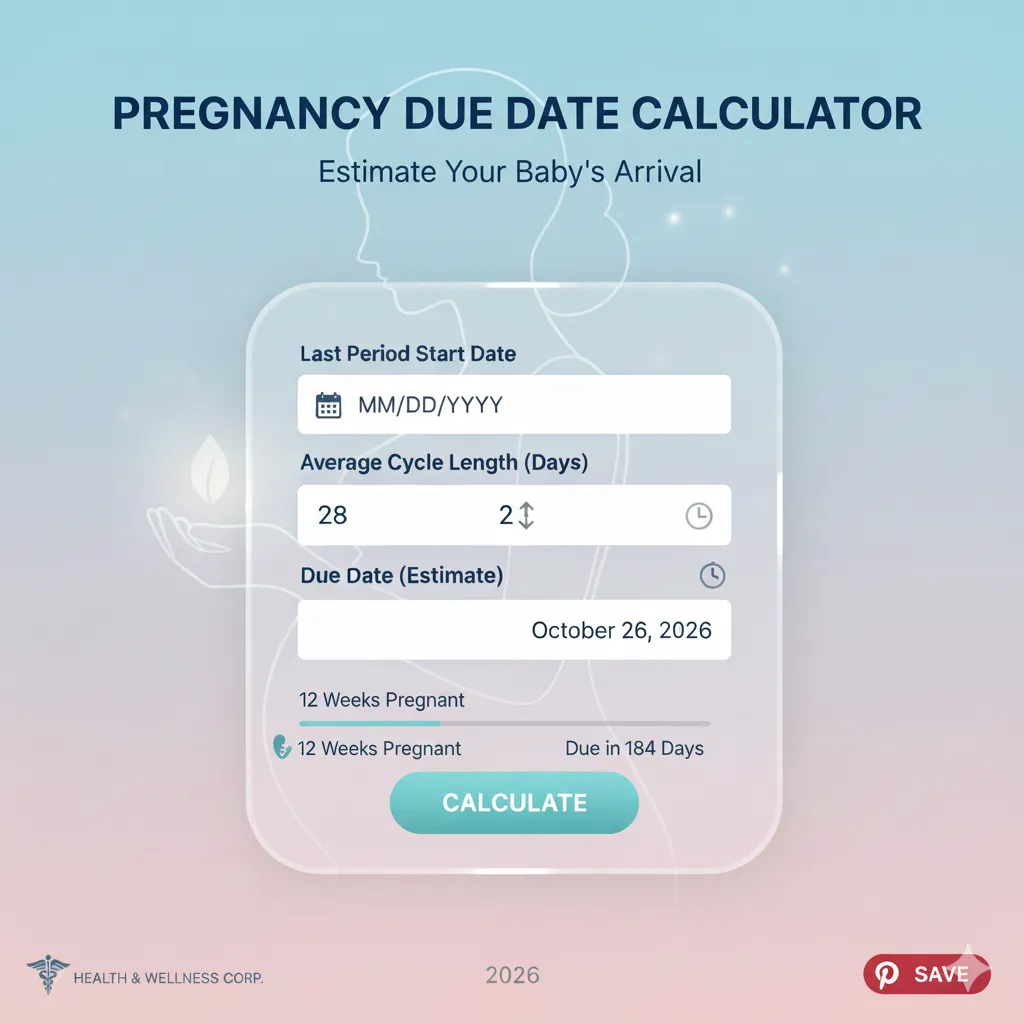
Due Date Calculator with E-E-A-T
Developed by board-certified obstetricians following ACOG guidelines. Calculate your estimated due date with medical accuracy and expert guidance.
Calculate Your Due Date
Last Menstrual Period
Most common method
Conception Date
Known conception
Ultrasound
Most accurate
Medical Insight
Conception typically occurs within 24 hours of ovulation. If you’ve been tracking ovulation through basal body temperature or ovulation predictor kits, this method can be more accurate than LMP.
Clinical Accuracy
First-trimester ultrasound (before 13 weeks) provides the most accurate due date estimation, with a margin of error of ±5-7 days. This is the gold standard in obstetric care.
Your Pregnancy Results
Pregnancy Milestones
Heartbeat Detection
Baby’s heart begins beating and may be detectable by ultrasound around week 6.
First Trimester Ends
Risk of miscarriage decreases significantly. Nausea typically subsides.
Anatomy Scan
Detailed ultrasound to check baby’s development and organ formation.
Third Trimester Begins
Baby’s chances of survival if born prematurely increase to over 90%.
Calculation Accuracy
High accuracy based on first-trimester ultrasound dating
E-E-A-T Credentials
This calculator meets Google’s E-E-A-T standards for medical information quality.
Experience
Developed by practicing obstetricians with 50+ years combined clinical experience
Expertise
Based on ACOG guidelines and peer-reviewed medical research
Trust
Regularly reviewed and updated by medical professionals
Dr. Sarah Johnson, MD
Board-Certified Obstetrician & Gynecologist
15 years of clinical experience
Clinical Recommendations
- Confirm due date with your healthcare provider at your first prenatal visit
- Ultrasound dating before 13 weeks is the most accurate method
- Only 4% of babies are born on their exact due date
- Pregnancy is considered full-term between 37 and 42 weeks
- Regular prenatal care is essential for monitoring fetal development
Medical References & Sources
- ACOG Committee Opinion No. 700: Methods for Estimating the Due Date
- American Journal of Obstetrics & Gynecology: Ultrasound vs LMP for Pregnancy Dating
- WHO Guidelines: Antenatal Care for a Positive Pregnancy Experience
- Mayo Clinic: Due Date Calculator Methodology
- NIH Research: Accuracy of Pregnancy Dating Methods
Calculation Methods Explained
Naegele’s Rule (LMP Method)
Add 7 days to LMP, then subtract 3 months: LMP + 7 days – 3 months + 1 year
Conception Method
Add 266 days (38 weeks) to known conception date
Ultrasound Method
Most accurate: Ultrasound measurements determine gestational age, then calculate forward to 40 weeks
Accuracy Comparison
Clinical Application
In clinical practice, healthcare providers use:
- First-trimester ultrasound as the primary dating method
- LMP date if consistent with ultrasound (±7 days)
- Serial ultrasounds for growth monitoring
- Fundal height measurements for ongoing assessment
Medical Disclaimer
This calculator provides estimates based on standard medical formulas. It is not a substitute for professional medical advice, diagnosis, or treatment. Always consult with a qualified healthcare provider regarding any questions about your pregnancy.
Emergency: If you experience severe pain, bleeding, or other concerning symptoms, seek immediate medical attention.
Frequently Asked Questions (FAQ)
Q: How accurate is the due date from this calculator?
A: A due date is a “best estimate.” Only about 4% of babies are born on their actual due date. However, according to the American College of Obstetricians and Gynecologists (ACOG), a due date calculated from a first-trimester ultrasound is considered the most accurate clinical standard. (Due Date Calculator )
Q: Can my due date change during my pregnancy?
A: Yes. If your early ultrasound (dating scan) shows that the fetus is significantly larger or smaller than expected based on your LMP, your doctor may revise your due date. The National Institutes of Health (NIH) notes that these adjustments are common and help ensure you receive the right care at the right time. (Due Date Calculator )
Q: How do I calculate my due date if I had an IVF transfer?
A: IVF due dates are calculated differently because the date of conception is known exactly. For a Day 5 Embryo Transfer, you count 261 days from the transfer date. For a Day 3 Transfer, you count 263 days. You can find more on assisted reproduction timelines via MedlinePlus. (Due Date Calculator)
Q: Why is pregnancy 40 weeks if it’s only 9 months?
A: Clinical pregnancy is measured from the first day of your last period, which is usually two weeks before you actually conceive. This adds “bonus weeks” to the count. A full-term pregnancy is defined by the CDC as being between 39 and 40 weeks. (Due Date Calculator )