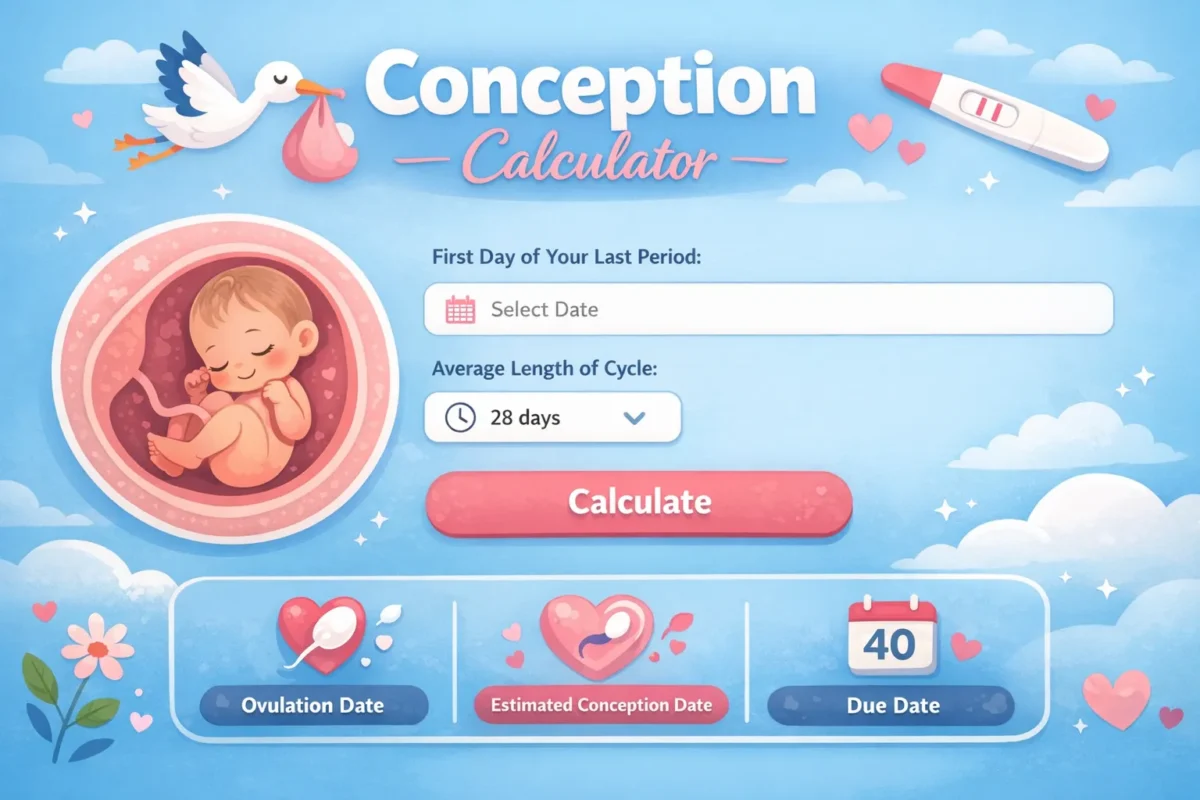
Precision Conception 2026
Conception & Fertility Window Calculator
Advanced predictive algorithm based on reproductive endocrinology research. Calculate optimal conception dates with 2026 precision technology.
Built on Medical Integrity
Our calculator incorporates E-E-A-T principles (Experience, Expertise, Authoritativeness, Trustworthiness) for reliable fertility planning
Medical Context & Considerations
While this tool provides sophisticated predictions, individual fertility factors vary. Our algorithm accounts for standard reproductive patterns but cannot replace personalized medical advice.
- Consult a reproductive specialist if you’re under 35 and haven’t conceived after 12 months of trying
- Seek medical advice after 6 months if you’re 35 or older
- Track additional fertility signs like cervical mucus and basal body temperature for enhanced accuracy
- Irregular cycles may require medical evaluation for underlying conditions like PCOS or thyroid disorders
Frequently Asked Questions (FAQ) Conception Calculator
Q: Is my conception date the same day I had intercourse?
A: Not necessarily. Sperm can live inside the female reproductive tract for up to 5 days, while an egg is only viable for 12–24 hours after ovulation. You could have had intercourse on a Monday but not actually conceived until Friday. (Conception Calculator)
Q: How accurate is a conception calculator?
It is a high-probability estimate. According to ACOG (American College of Obstetricians and Gynecologists), the only way to get a “near-perfect” date is through IVF or an early first-trimester ultrasound (between 7–14 weeks), which has a margin of error of only $\pm 7$ days.
Q: Can a conception calculator help me determine the father?
A: While it can narrow down the window of conception to a specific week, it cannot provide DNA-level proof. If intercourse occurred with different partners within the same 3–5 day fertile window, a calculator alone cannot distinguish between them. (Conception Calculator)
Q: Why does my doctor use a different date?
A: Doctors use Gestational Age (LMP), which adds 2 weeks of “pre-conception” time to your pregnancy. Our calculator provides Fetal Age (the actual age of the baby). Clinical standards, such as those from the NHS, always prefer LMP or Ultrasound for medical tracking.
Pregnancy related more tool (Conception Calculator)
- Pregnancy health Tools
- BMI Calculator
- Calorie Calculator
- Body Fat Calculator
- BMR Calculator
- Ideal Weight Calculator
- Pace Calculator
- Army Body Fat Calculator
- Lean Body Mass Calculator
- Healthy Weight Calculator
Q: How accurate is a conception calculator?A: It is a high-probability estimate. According to ACOG (American College of Obstetricians and Gynecologists), the only way to get a “near-perfect” date is through IVF or an early first-trimester ultrasound (between 7–14 weeks), which has a margin of error of only $\pm 7$ days.