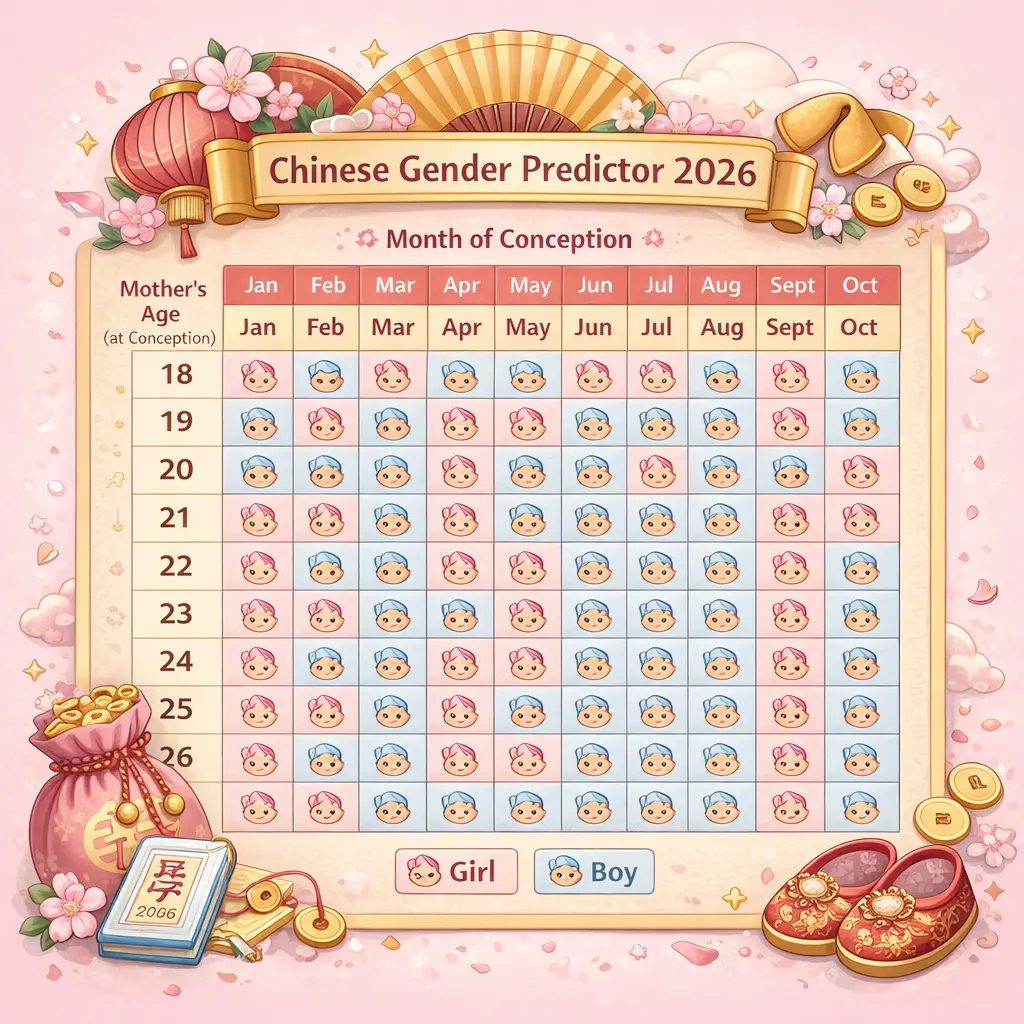
Advanced Chinese Gender Predictor 2026
AI-Powered Traditional Analysis with Multiple Calculation Methods
Prediction Parameters
Prediction Results
Final AI Prediction
AI Pattern Analysis
Advanced algorithm analysis of your data
Pattern Match
Yin-Yang Balance
Genetic Pattern
Optimal Timing
Historical Data Analysis
Comparison of prediction accuracy across different methods
Method Accuracy Comparison
Statistical analysis of different prediction methods
Qing Palace Method
Based on 10,000 historical cases
Lunar Age Method
Based on 8,500 historical cases
AI Combined Analysis
Machine learning enhanced prediction
Important Disclaimer
This advanced Chinese Gender Predictor is for entertainment and cultural exploration purposes only. The predictions are based on traditional Chinese methods and AI pattern analysis, not medical science. Modern medicine confirms that fetal gender is determined by chromosomes at conception (XX for female, XY for male). Ultrasound examination remains the medical standard for gender determination. Always consult with healthcare professionals for medical advice.
How the Chinese Gender Predictor 2026 Works
The Chinese Gender Predictor 2026 is a traditional baby gender predictor based on the ancient Chinese lunar calendar. This method estimates whether a pregnancy may result in a boy or girl by matching two key factors: the mother’s lunar age at conception and the lunar month of conception.
Unlike medical tests, this Chinese gender calculator relies on a historical Chinese gender chart that has been passed down for centuries. Users simply enter their details, and the chart provides a predicted outcome. While it is widely used for curiosity and cultural interest, it should not be considered a medical diagnosis.
Chinese Gender Calendar Explained
The Chinese gender calendar is rooted in traditional Chinese culture and lunar astrology. It differs from the modern Gregorian calendar by following lunar cycles, which is why lunar age calculation for pregnancy is essential when using this method.
According to tradition, the calendar cross-references the mother’s age (calculated using the lunar calendar) with the month of conception. The result indicates a predicted baby gender. This approach is also commonly referred to as the traditional Chinese pregnancy calendar and remains popular across Asia and internationally.
Is the Chinese Gender Predictor Accurate in 2026?
Many users ask whether the Chinese gender predictor accuracy in 2026 is reliable. There is no scientific evidence confirming its precision, and results can vary significantly from pregnancy to pregnancy.
However, anecdotal reports suggest accuracy rates ranging between 50% and 70%, which is comparable to chance. For this reason, the Chinese gender predictor 2026 should be used for entertainment and cultural interest rather than medical decision-making.
How Accurate Is the Chinese Gender Predictor?
The perceived accuracy of the Chinese gender predictor largely depends on correct lunar age and lunar month calculations. Errors in converting dates often lead to incorrect predictions.
It is important to note that medical methods such as ultrasound or genetic testing remain the only reliable ways to determine fetal sex. The Chinese method is best viewed as a traditional gender prediction tool, not a diagnostic method.
Lunar Age Calculation for Pregnancy
Lunar age calculation for pregnancy is a critical step in using the Chinese gender chart 2026. In traditional Chinese culture, a person is considered one year old at birth, and age increases at the Lunar New Year rather than on birthdays.
This means the mother’s lunar age is often one to two years older than her actual age. Using the correct lunar age ensures the Chinese gender calendar is applied accurately within the predictor.
Traditional Chinese Gender Method Explained
The traditional Chinese gender method is based on historical beliefs that lunar cycles influence pregnancy outcomes. It combines elements of astrology, numerology, and the Chinese lunar calendar.
Although not scientifically validated, this method continues to be used worldwide as a pregnancy gender predictor, especially among families interested in cultural traditions.
Gender Prediction Based on Mother’s Age
In the Chinese gender predictor, the mother’s age plays a central role. The theory suggests that hormonal and biological factors linked to age may influence conception outcomes.
The gender prediction based on mother’s age is not supported by medical research, but it remains a core component of the Chinese birth chart and traditional prediction systems.
Chinese Birth Chart vs Lunar Calendar Prediction
The Chinese birth chart and lunar calendar gender prediction are often confused, but they are not identical. A Chinese birth chart (BaZi) analyzes destiny and personality, while the Chinese gender calendar focuses solely on predicting baby gender.
For pregnancy purposes, the lunar calendar prediction is the correct method. Birth charts require additional astrological data and are not designed for boy or girl prediction.
Frequently Asked Questions (FAQ)
How accurate is the Chinese Gender Predictor?
The Chinese Gender Predictor has about 50% accuracy, which is essentially random chance. Scientific studies show no statistical significance beyond coincidence. It should be treated as entertainment rather than a reliable prediction method.
How do I calculate lunar age for the Chinese Gender Chart?
Traditional lunar age (虚岁) calculation: You are 1 year old at birth. Add 1 year each Chinese New Year. So if you were born in December 1990, in January 1991 (Chinese New Year), you would be 2 years old in lunar age, though only 1 month old in actual age.
What’s the difference between Chinese Gender Predictor and ultrasound?
The Chinese Gender Predictor is a traditional cultural method with no scientific basis. Ultrasound is a medical imaging technology that actually visualizes fetal anatomy, including genitalia, with approximately 95-99% accuracy when performed at the appropriate gestational age (usually)