Calorie Calculator
Calculating your calories is the first step toward a successful fitness journey. Our Daily Calorie Calculator uses your Basal Metabolic Rate (BMR) and Activity Level to determine exactly how much energy your body burns every 24 hours.
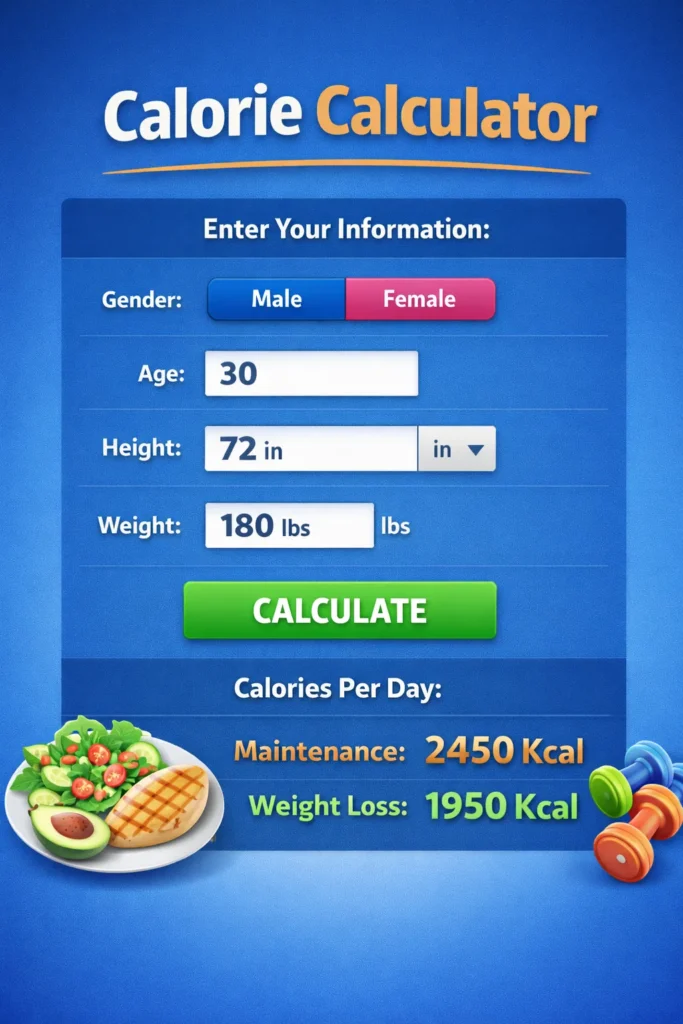
Calorie Calculator
Calculate Your Daily Calorie Needs | Personalized Nutrition for Your Weight Goals
Calculate Your Daily Calories
Your Daily Calorie Needs
Calorie Breakdown
Expected Weekly Progress
Based on calorie deficit of 500-1000 calories/day
Recommended Macronutrients
Protein
176g
Carbs
235g
Fats
78g
Understanding Total Daily Energy Expenditure (TDEE)
TDEE is the total number of calories your body burns in a day, including basal metabolic rate (BMR) and physical activity.
TDEE Formula
TDEE = BMR × Activity Multiplier
BMR is calculated using the Mifflin-St Jeor Equation:
Men: BMR = 10 × weight(kg) + 6.25 × height(cm) – 5 × age(y) + 5
Women: BMR = 10 × weight(kg) + 6.25 × height(cm) – 5 × age(y) – 161
Your TDEE represents the number of calories you need to maintain your current weight. To lose weight, consume fewer calories than your TDEE. To gain weight, consume more.
Understanding Macronutrients
| Macronutrient | Calories per gram | Recommended % | Primary Function |
|---|---|---|---|
| Protein | 4 calories | 25-35% | Muscle repair, enzyme production |
| Carbohydrates | 4 calories | 45-65% | Primary energy source |
| Fats | 9 calories | 20-35% | Hormone production, nutrient absorption |
Macronutrient Calculation Example
For a 2,000 calorie diet with 30% protein, 40% carbs, 30% fat:
- Protein: 2,000 × 0.30 ÷ 4 = 150g
- Carbs: 2,000 × 0.40 ÷ 4 = 200g
- Fat: 2,000 × 0.30 ÷ 9 = 67g
Adjusting Macros for Goals
Weight Loss: Higher protein (30-35%), moderate carbs (40-45%)
Muscle Gain: Higher protein (25-30%), higher carbs (45-50%)
Maintenance: Balanced approach (25-30% protein, 45-55% carbs)
Activity Level Multipliers
| Activity Level | Multiplier | Description |
|---|---|---|
| Sedentary | 1.2 | Little or no exercise, desk job |
| Lightly Active | 1.375 | Light exercise 1-3 days/week |
| Moderately Active | 1.55 | Moderate exercise 3-5 days/week |
| Very Active | 1.725 | Hard exercise 6-7 days/week |
| Extra Active | 1.9 | Very hard exercise & physical job |
Be Honest
Choose the activity level that truly represents your daily life, not your aspirations.
Non-Exercise Activity
Remember to include daily activities like walking, household chores, and standing.
Adjust Regularly
Recalculate if your activity level changes significantly (e.g., new job, injury, training program).
Nutrition Tips for Success
Prioritize Protein
Include protein with every meal to support muscle retention and increase satiety during weight loss.
Choose Complex Carbs
Opt for whole grains, vegetables, and legumes over refined carbohydrates for sustained energy.
Healthy Fats Are Essential
Include sources like avocados, nuts, seeds, and olive oil for hormone health and nutrient absorption.
Track Progress, Not Perfection
Use the calorie target as a guide, but focus on consistency and overall dietary patterns.
Stay Hydrated
Drink water before meals and throughout the day. Thirst is often mistaken for hunger.
Plan Your Meals
Prepare meals in advance to avoid impulsive food choices when hungry.
Sample Meal Plan (2,000 calories)
- Breakfast: Greek yogurt with berries and nuts (400 calories)
- Lunch: Grilled chicken salad with olive oil dressing (500 calories)
- Snack: Apple with almond butter (200 calories)
- Dinner: Salmon with quinoa and roasted vegetables (700 calories)
- Evening: Protein shake (200 calories)
Important Medical Disclaimer
This calorie calculator is for informational purposes only. Individual calorie needs may vary based on metabolism, health conditions, medications, and other factors. Always consult with a healthcare provider or registered dietitian before making significant changes to your diet, especially if you have medical conditions.
The minimum recommended calorie intake is 1,200 calories per day for women and 1,500 calories per day for men. Consuming fewer calories than these minimums can lead to nutrient deficiencies and health complications.
Frequently Asked Questions
What is TDEE?
A: TDEE stands for Total Daily Energy Expenditure. It is the total number of calories your body burns in a 24-hour period based on your activity level, age, and biology. According to the National Institutes of Health (NIH), TDEE is composed of your basal metabolism, the thermic effect of food, and physical activity.
Is 1,200 calories enough?
A: For most adults, eating fewer than 1,200 (women) or 1,500 (men) calories is not recommended without strict medical supervision. Extremely low-calorie diets can lead to nutrient deficiencies and metabolic slowing. The CDC clinical guidelines emphasize that caloric intake should be balanced with nutritional quality to maintain long-term health.
How accurate is this?
A: While this tool uses the Mifflin-St Jeor formula—widely considered the gold standard for population-wide accuracy—individual factors like muscle mass can influence results. Muscle is more metabolically active than fat, meaning individuals with high lean mass may actually require more calories than standard formulas suggest.