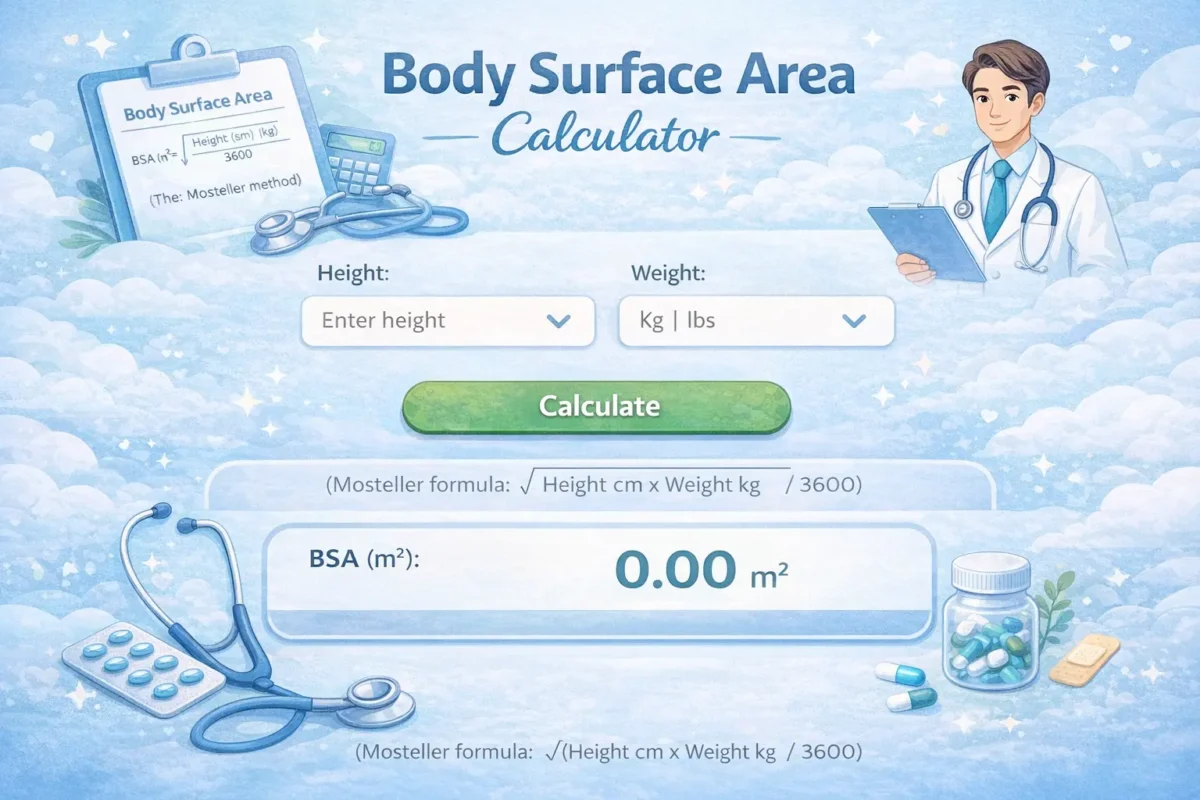
Body Surface Area Calculator 2026
Dual-purpose tool for medical drug dosing and athlete metabolic calculations. Calculate body surface area using Du Bois, Mosteller, and other validated formulas.
Calculate Your Body Surface Area
Body Surface Area (BSA) is the measured or calculated surface area of the human body. It’s used for medical purposes (drug dosing, chemotherapy) and fitness applications (metabolic rate, calorie needs).
BSA Applications & Formulas
What is Body Surface Area?
Body Surface Area (BSA) is the total surface area of the human body. Unlike BMI which only considers weight and height, BSA provides a more accurate measure of metabolic mass and is less affected by abnormal adipose tissue.
Medical Applications
- Chemotherapy dosing: Precise drug calculations in oncology
- Renal function: Glomerular filtration rate (GFR) adjustment
- Cardiac index: Cardiac output normalization
- Burn assessment: Percentage of body surface burned
- Pediatric dosing: Age-adjusted medication calculations
Fitness Applications
- Metabolic rate: BMR and TDEE calculations
- Calorie needs: Personalized nutrition planning
- Fluid requirements: Hydration planning for athletes
- Body composition: Lean mass vs fat mass analysis
- Performance metrics: VO₂ max normalization
BSA Formulas Explained
Du Bois Formula (1916) – Clinical Gold Standard
BSA (m²) = 0.007184 × Height0.725 × Weight0.425
Where height is in cm and weight in kg. Derived from direct measurements of 9 subjects.Mosteller Formula (1987) – Simplified Calculation
BSA (m²) = √(Height × Weight / 3600)
Simplified version easy to calculate manually. Height in cm, weight in kg.Haycock Formula (1978) – Pediatric Focus
BSA (m²) = 0.024265 × Height0.3964 × Weight0.5378
Developed specifically for infants and children. More accurate for pediatric populations.Important Clinical Note
For chemotherapy and critical drug dosing, always use the Du Bois formula unless institutional protocols specify otherwise. BSA-based dosing reduces toxicity while maintaining efficacy for many chemotherapy agents.
Fitness Application Note
BSA correlates well with basal metabolic rate (BMR). Multiply your BSA by 1,800-2,200 to estimate daily calorie needs for weight maintenance, depending on activity level.
BSA vs BMI: When to Use Each
| Metric | Purpose | Calculation | Best For | Limitations |
|---|---|---|---|---|
| Body Surface Area (BSA) | Metabolic mass, drug dosing | Height & weight with exponents | Medical dosing, metabolic calculations | Complex calculation, less known |
| Body Mass Index (BMI) | Weight classification | Weight/Height² (simple) | Population health, screening | Poor for athletes, ignores body composition |
Frequently Asked Questions (FAQ) Body Surface Area Calculator
Q: What is the average BSA for an adult?
The “average” BSA is generally considered to be $1.73\ m^2$ for a man and $1.6\ m^2$ for a woman. According to the National Institutes of Health (NIH)
, this $1.73\ m^2$ value is the standard used to normalize medical tests like GFR (kidney function).
Q: Why do doctors use BSA instead of weight for medicine?
Many medications, especially chemotherapy and steroids, are dosed by BSA because it correlates more closely with cardiac output and the body’s ability to metabolize drugs. Research from the Mayo Clinic suggests that BSA-based dosing reduces the risk of toxicity in patients with varying body compositions.
Q: Is BSA used in fitness or bodybuilding?
A: Yes. BSA is used to calculate the Thermic Effect of Food and basal metabolism more accurately than weight alone. Athletes use it to determine heat dissipation requirements, as a larger surface area allows for faster cooling during intense exercise.
Q: How accurate are BSA calculations? (BSA calculator)
A: Formulas are estimates. While the Mosteller and Du Bois formulas are very accurate for most people, the American Journal of Clinical Oncology notes that direct measurement (3D body scanning) is the only “perfect” method, though it is rarely necessary outside of specialized research.