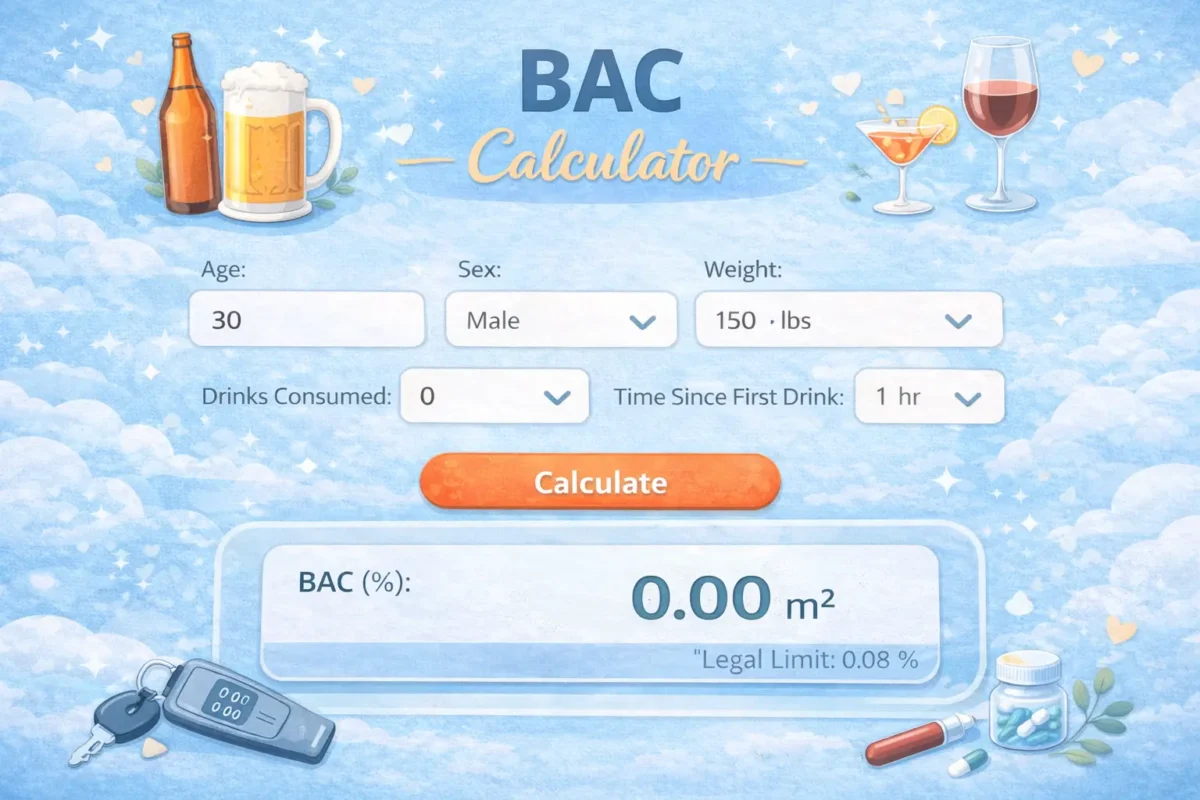
Clinical BAC Calculator 2026
Educational tool for estimating Blood Alcohol Content. Results are ESTIMATES only – NEVER a “green light” to drive.
CRITICAL SAFETY DISCLAIMER
This calculator provides ESTIMATES only. Individual BAC varies widely. NEVER use this tool to determine if you’re “safe to drive.” The only safe BAC for driving is 0.00%.
Estimate Your BAC
This tool uses the Widmark formula with clinical adjustments for absorption and elimination rates. Results are ESTIMATES with ±0.02% potential error.
Accuracy Limitations
BAC estimates vary based on metabolism, food intake, medication, genetics, and health conditions. This tool provides educational estimates only.
Safety Information & YMYL Compliance
YMYL Medical Disclaimer
This tool falls under Google’s strictest Your Money Your Life (YMYL) category as it provides information affecting human safety. Therefore:
- Results are ESTIMATES with ±0.02% margin of error
- Individual BAC varies based on 20+ physiological factors
- This is NOT a medical device or diagnostic tool
- NEVER use BAC estimates to make driving decisions
- Consult clinical testing for accurate BAC measurement
Clinical BAC Effects by Level
0.00 – 0.02% BAC
Effects: Slight mood elevation, mild relaxation
Impairment: Minimal but detectable in lab tests
Driving Risk: 1.4x higher than sober
0.03 – 0.05% BAC
Effects: Reduced coordination, euphoria
Impairment: Judgment decline begins
Driving Risk: 2x higher than sober
0.08% BAC (Legal Limit)
Effects: Poor coordination, blurred vision
Impairment: Severe reaction time decline
Driving Risk: 4x higher than sober
0.15 – 0.30% BAC
Effects: Confusion, vomiting, loss of balance
Impairment: Gross motor skills failure
Risk: Alcohol poisoning possible
Factors Affecting BAC Accuracy
Safe Alternatives to Driving
Rideshare/Taxi
Cost: $10-30 average
Apps: Uber, Lyft, local taxi
Safety: Designated driver without knowing them
Designated Driver
Cost: Free (rotating responsibility)
Planning: Arrange before drinking
Benefit: Most reliable option
Stay Overnight
Cost: $0 if at friend’s place
Safety: Zero driving risk
Benefit: No morning hangover drive
Public Transit
Cost: $2-5 average
Availability: Check schedules
Safety: Professional drivers
Clinical vs. Estimated BAC
This Calculator: Estimates using Widmark formula (±0.02% error)
Breathalyzer: Measures breath alcohol (±0.005% error when calibrated)
Blood Test: Clinical gold standard (±0.001% error)
Important: Only clinical tests are legally admissible. This tool is for education only.
2026 Legal Updates & Keywords
Primary Keywords for SEO: BAC calculator, blood alcohol content calculator, alcohol calculator, drink driving calculator, blood alcohol level, BAC estimate, sober calculator, alcohol impairment calculator
2026 Legal Trends: Lower limits (0.05% in more states), zero-tolerance for commercial drivers, increased rideshare integration with bars
Safety Technology: Ignition interlock devices, mobile breathalyzer apps (for tracking, not driving decisions), AI impairment detection
Frequently Asked Questions (FAQ)
Q: What is the legal BAC limit for driving?
A: In most U.S. states and many other countries, the legal limit for drivers 21 and older is 0.08%. However, the National Highway Traffic Safety Administration (NHTSA) warns that impairment begins at much lower levels, often as low as 0.02%.
Q: How long does it take for BAC to drop to zero?
A: There is no way to “speed up” sobriety. Coffee, cold showers, or exercise do not lower your BAC. The only factor that reduces BAC is time. According to the Mayo Clinic, the liver processes approximately one standard drink per hour.
Q: What counts as a “Standard Drink”?
A: A standard drink is defined as containing roughly 14 grams of pure alcohol. This typically equals:
12 ounces of regular beer (5% ABV).
5 ounces of wine (12% ABV).
1.5 ounces of distilled spirits (40% ABV).
Q: Can I use a BAC calculator for legal defense?
A: No. Online calculators are for educational purposes only. Factors like medication, specific metabolism, and recent food intake make it impossible for a digital tool to match a professional breathalyzer or blood test. Always choose a designated driver.